Long-term investment strategies are the foundation of most successful wealth-building plans. Rather than trying to time the market or chase short-term momentum, a long-term approach focuses on holding a diversified mix of assets for years or decades, letting compounding do the heavy lifting. For US investors, the tools have never been more accessible: low-cost index funds, tax-advantaged retirement accounts, and fractional shares let almost anyone build a disciplined portfolio. This guide explains the core strategies, how they work, and how to apply them in practice.
Why Time in the Market Beats Timing the Market
The single most important input to long-term returns is how long your money stays invested. According to research from Morningstar, US large-cap stocks have historically delivered positive returns in roughly three out of every four calendar years, but the odds of a positive return rise substantially as the holding period lengthens. Over rolling 10- and 20-year windows, broad stock market returns have been positive far more often than not.
That matters because missing just a handful of the market's best days can sharply reduce returns. Attempting to sidestep downturns often means missing the recovery, which tends to arrive quickly and unpredictably. A long-term investor accepts volatility as the price of higher expected returns and stays invested through cycles.
Core Strategy 1: Low-Cost Index Fund Investing
For most people, the highest-probability path to solid long-term returns is owning the whole market at a low cost. Index funds and exchange-traded funds (ETFs) track benchmarks like the S&P 500 or the CRSP US Total Market Index, giving you broad diversification in a single holding.
Costs compound just like returns, in reverse. The expense ratio difference between a 0.03% index fund and a 1% actively managed fund can amount to tens of thousands of dollars over a 30-year horizon on a six-figure balance. A few practical rules:
- Favor broad-market index funds and ETFs with expense ratios well under 0.20%.
- Use total market or S&P 500 funds as your domestic core, then add international and bond exposure.
- Avoid funds with sales loads, high turnover, or opaque strategies you cannot explain in one sentence.
Core Strategy 2: Asset Allocation and Diversification
Asset allocation — the split between stocks, bonds, and other assets — explains most of the variation in portfolio returns over time. Your mix should reflect your time horizon and tolerance for drawdowns, not your mood about the market.
A common starting framework is the “110 minus age” rule, where the stock percentage equals 110 minus your age, with the remainder in bonds. A 30-year-old would hold roughly 80% stocks and 20% bonds; a 60-year-old closer to 50/50. This is a heuristic, not a law, but it captures the key idea: the further you are from needing the money, the more equity risk you can reasonably carry.
Diversification should extend beyond US stocks. International equities and bonds reduce concentration in any single market, and within stocks, broad funds spread your money across hundreds or thousands of companies and sectors.
Core Strategy 3: Dollar-Cost Averaging and Automatic Contributions
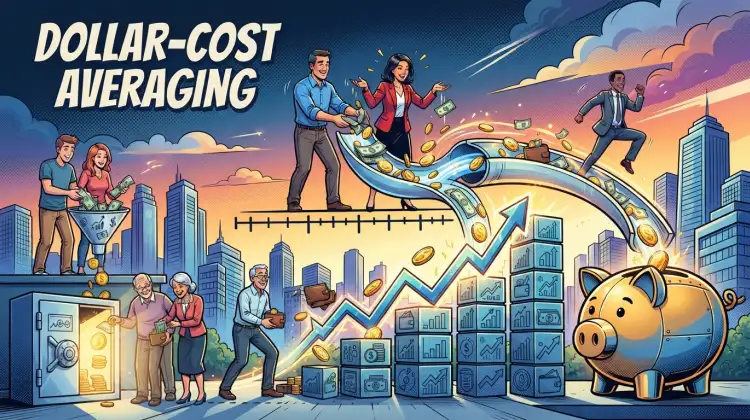
Dollar-cost averaging means investing a fixed amount on a regular schedule regardless of price. It removes emotion from the process and ensures you buy more shares when prices are low and fewer when they are high.
For most investors the most powerful version of this is automatic payroll deferral into a workplace plan such as a 401(k). Contributions go in every pay period, and if your employer offers a match, capturing the full match is one of the highest guaranteed returns available. Individual retirement accounts (IRAs) and taxable brokerage accounts can be automated the same way with recurring transfers.
Rebalancing: Keeping the Plan on Track
Over time, strong stock performance can push your allocation away from its target. Rebalancing — periodically selling overweight assets and buying underweight ones — restores your intended risk level. Many investors rebalance annually or when an allocation drifts more than 5 percentage points from target. Doing it inside a tax-advantaged account avoids triggering capital gains.
Tax-Advantaged Accounts and Tax Efficiency
Where you hold investments matters as much as what you hold. Prioritize tax-advantaged space before taxable accounts:
- 401(k) and 403(b): Contribute at least enough to earn the full employer match, then increase toward the annual contribution limit.
- Traditional and Roth IRAs: Use these for additional retirement savings; Roth contributions are made with after-tax dollars and grow tax-free.
- Health savings accounts (HSAs): If you have a qualifying high-deductible health plan, an HSA offers a rare triple tax advantage and can serve as a long-term retirement vehicle.
- Taxable brokerage: Hold tax-efficient index funds here, and favor long-term capital gains treatment by holding positions more than one year.
How to Build Your Own Long-Term Plan
Start with your goal and time horizon, then work backward. A simple, effective process looks like this:
- Define the goal (retirement, education, financial independence) and the date you need the money.
- Set an emergency fund of three to six months of expenses in cash before investing aggressively.
- Choose a target allocation consistent with your horizon and risk tolerance.
- Select low-cost funds to implement that allocation.
- Automate contributions and review the plan once or twice a year — not daily.
- Rebalance as needed and increase contributions as income grows.
Discipline, low costs, and time are the levers you control. Market returns are not. Focus on what you can control and let the rest play out over decades.
What to Remember
Long-term investment strategies work because they align your money with compounding, diversification, and low costs rather than prediction. Own broad, cheap index funds; set an allocation that matches your time horizon; automate contributions through tax-advantaged accounts; and rebalance periodically. The plan does not need to be complicated — it needs to be consistent. Investors who stay the course through market cycles have historically been rewarded far more reliably than those who trade on headlines.