Deciding whether to buy or rent is one of the largest financial choices most U.S. households make, and the honest answer is that neither option wins universally. The right call depends on how long you plan to stay, local price-to-rent ratios, your tax situation, and how much liquidity you need. This comparison breaks down the actual cash flows on both sides, the costs buyers routinely underestimate, and the math that determines when owning pulls ahead.
The true cost of owning a home
Buying is not just a mortgage payment. A realistic ownership budget includes several layers:
- Principal and interest. On a 30-year fixed-rate mortgage, the payment is stable, but early payments are mostly interest. A $400,000 loan at 6.5% costs about $2,528 per month in principal and interest alone.
- Property taxes. These vary widely by state and county and typically rise with assessed value. Budget 0.5% to 2.5% of home value annually depending on jurisdiction.
- Homeowners insurance. Often $1,200 to $3,000 or more per year, higher in disaster-prone areas.
- Maintenance and repairs. A common planning rule is 1% of home value per year, though older homes and major systems (roof, HVAC) can spike far above that.
- Closing costs and transaction fees. Buyers typically pay 2% to 5% of the purchase price up front, and sellers commonly pay 6% to 8% in agent commissions and closing costs when they sell.
- Mortgage insurance. If your down payment is under 20% on a conventional loan, private mortgage insurance (PMI) adds to the monthly bill until you build enough equity.
Add those up and the all-in monthly cost of owning is frequently 30% to 50% higher than the principal-and-interest figure alone.
The true cost of renting
Renting looks simpler, but it has its own economics. Your rent covers the landlord's costs plus a profit margin, so you are indirectly paying taxes, insurance, and maintenance. The trade-offs are:
- Rent increases. Unlike a fixed-rate mortgage, rent resets at lease renewal and can rise faster than inflation in tight markets.
- No equity build. Rent payments do not increase your net worth, though the money you avoid spending on a down payment can be invested.
- Lower frictions. Moving costs are modest, and you avoid the 8% to 13% round-trip transaction costs of buying and later selling.
- Predictable upkeep. Repairs are the landlord's responsibility, which caps your downside risk.
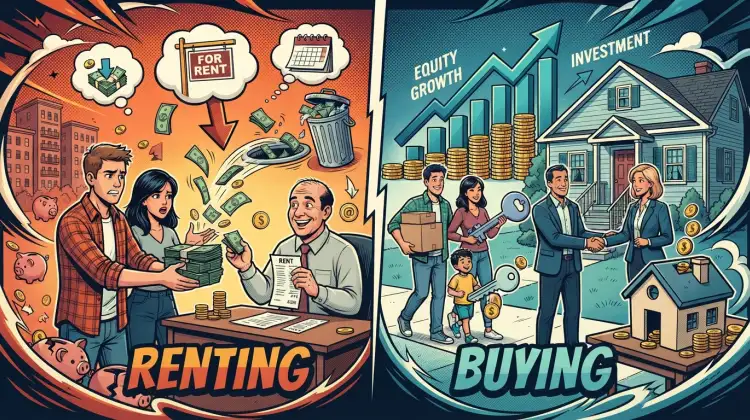
Renting is often financially superior for short horizons, in high-price/low-rent markets, and for households that value mobility or need to keep cash liquid.
The opportunity cost most comparisons miss
A down payment is capital that could be invested elsewhere. If you put $80,000 down on a home, you forgo the return that money could earn in a diversified portfolio. Historically, U.S. stocks have returned roughly 7% annually after inflation over long periods, though with far more volatility than home equity. A rigorous comparison should subtract the investment return on your down payment and on the monthly cost gap between owning and renting from the equity you build as an owner.
Home price appreciation is not guaranteed. Nationally, home values have grown modestly above inflation over decades, but individual markets can stagnate or fall for years. Treating appreciation as a reliable 5% annual return overstates the case for buying.
Tax treatment: what actually changes your numbers
U.S. tax rules favor owners, but less than many people assume after the Tax Cuts and Jobs Act raised the standard deduction. Key points:
- Mortgage interest deduction. You can deduct interest on up to $750,000 of qualified mortgage debt ($375,000 if married filing separately) on a primary residence. This only helps if your itemized deductions exceed the standard deduction ($15,000 for single filers and $30,000 for married filing jointly in 2025).
- Property tax deduction. State and local taxes, including property taxes, are capped at $10,000 combined under the SALT cap.
- Capital gains exclusion. If you have lived in the home as your primary residence for two of the last five years, you can exclude up to $250,000 of gain ($500,000 for married couples) from federal tax.
Renters get no federal deduction for rent, but they also avoid the costs that generate those deductions.
How to run the breakeven calculation
The breakeven horizon is the number of years you must own before total ownership costs fall below total renting costs, accounting for equity and transaction costs. A practical method:
- Estimate the all-in monthly cost of owning (principal, interest, taxes, insurance, PMI, maintenance).
- Subtract the principal portion of each payment, since that builds equity you keep.
- Compare that net cost to local rent, and add the investment return you would earn on the down payment and closing costs.
- Divide total buying transaction costs plus selling costs by the monthly savings (or add the monthly shortfall) to find the breakeven month count.
In many U.S. markets, breakeven lands between four and seven years. If you expect to move sooner, renting usually wins. Use a reputable rent-vs-buy calculator, such as the one published by NerdWallet or the Federal Reserve Bank of Atlanta's home ownership affordability tools, and test your assumptions at different appreciation and investment-return rates.
Matching the decision to your financial situation
Buying tends to make sense when you have a stable income, plan to stay at least five to seven years, hold an emergency fund after closing, and can keep housing costs under roughly 28% to 30% of gross income. Renting tends to make sense when your career is mobile, you lack a fully funded emergency reserve, or local price-to-rent ratios are stretched. Either way, avoid treating a home as a short-term investment; its value is primarily shelter with a long-run store of equity.
What to Remember
- Compare all-in ownership costs, not just the mortgage payment.
- Account for the opportunity cost of your down payment and transaction costs.
- Tax benefits are real but smaller than many buyers expect after the higher standard deduction.
- Use a breakeven timeline tied to how long you will actually stay.
- Keep liquidity: an emergency fund matters more than squeezing into a purchase.