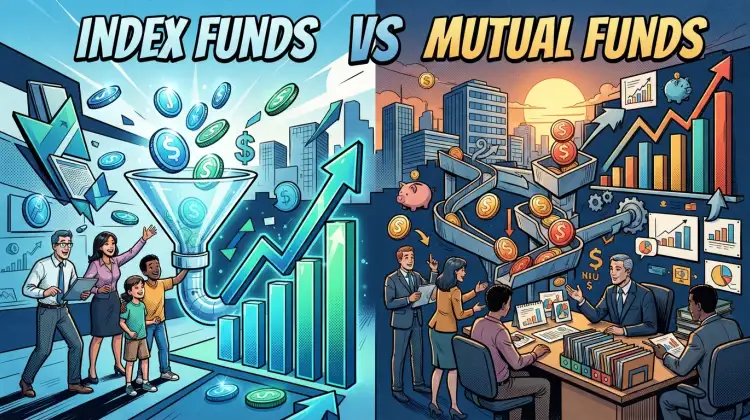
The phrase "index funds vs mutual funds" trips up a lot of new investors, because it sets up a comparison that isn't quite apples to apples. An index fund is a type of mutual fund — or, increasingly, a type of exchange-traded fund (ETF). The real question is whether you want a fund that simply tracks a market benchmark or one where a manager actively picks securities in an attempt to beat it. That distinction drives differences in cost, taxes, and the odds of outperforming, and it's the one worth understanding before you invest a dollar.
What Is an Index Fund?
An index fund is built to replicate the performance of a specific benchmark, such as the S&P 500 or the CRSP US Total Market Index. Instead of a manager choosing stocks, the fund holds the securities in the index in roughly the same proportions. When the index changes, the fund adjusts. Because there's no research team making buy-and-sell calls, index funds tend to carry low expense ratios — often under 0.10% for broad-market funds, and sometimes as low as 0.03%.
Index funds come in two structures:
- Index mutual funds — priced once daily after market close, bought and sold directly through the fund company or a brokerage, and often available in fractional dollars.
- Index ETFs — trade on an exchange throughout the day like a stock, generally with even lower expense ratios and strong tax efficiency.
Both do the same job. The wrapper matters mainly for how you trade and how you're taxed.
What Is an Actively Managed Mutual Fund?
When people say "mutual funds" in contrast to index funds, they usually mean actively managed mutual funds. A portfolio manager and analyst team research companies, forecast earnings, and buy and sell holdings with the goal of beating a benchmark. You're paying for that judgment through the expense ratio, which for actively managed US equity funds commonly runs between 0.50% and 1.00% or more, and sometimes includes a sales load on top.
Active management isn't inherently bad. Some managers add value in less efficient corners of the market, such as small-cap stocks, emerging markets, or certain bond sectors, where information is harder to come by. The question is whether the outperformance, after fees, is reliable enough to count on.
Costs, Taxes, and the Odds of Beating the Market
The evidence on active management is sobering. S&P Dow Jones Indices' SPIVA research has consistently found that the majority of large-cap active funds underperform the S&P 500 over 10- and 15-year horizons — often more than 80% to 90% of them. That isn't because managers are unskilled; it's because the market is competitive, and fees are a permanent headwind.
Taxes widen the gap in taxable accounts. Active funds trade more frequently, realizing capital gains that get passed to shareholders. Index funds, which change holdings rarely, defer most gains and are far more tax-efficient. In a 401(k) or IRA, that advantage disappears, but the fee advantage remains.
A simple illustration: a $100,000 portfolio earning 7% annually grows to about $761,000 over 30 years at a 0.05% expense ratio. At 1.00%, it grows to roughly $574,000. That gap — nearly $190,000 — is money paid to the fund, not earned by it.
When a Mutual Fund Might Make Sense
Index funds are a strong default for most investors building long-term wealth, but there are situations where an actively managed mutual fund deserves a look:
- Retirement plans with limited menus. If your 401(k) offers only a handful of funds, the best available option may be active.
- Specialized exposures. Certain municipal bond, high-yield, or niche international strategies are harder to index cleanly.
- Downside management. Some active funds aim to lose less in drawdowns, which may suit risk-averse investors — though you should verify that against the fund's actual record.
If you go active, favor low-cost funds with manager tenure, a clear process, and a track record you can evaluate against the right benchmark.
How to Decide for Your Portfolio
Start with your account type. In tax-advantaged accounts like a 401(k), traditional IRA, or Roth IRA, prioritize low expense ratios and broad diversification; the tax argument for indexing is muted. In a taxable brokerage account, index funds and ETFs usually win on tax efficiency alone.
Then consider your temperament and time. Index investing requires patience through volatility but removes the risk of picking the wrong manager. Active investing demands ongoing monitoring — you must decide when to sell a fund that lags, which is itself a difficult call.
For most people, a core of low-cost total-market and international index funds, held for decades and rebalanced periodically, is a sensible foundation. Active funds can play a supporting role if you have a specific reason to use them.
The Short Version
Every index fund is a mutual fund or ETF, but not every mutual fund is an index fund. Index funds track a benchmark at low cost and high tax efficiency; actively managed mutual funds charge more in exchange for a manager's attempt to beat the market, an attempt that fails more often than it succeeds. For most US investors, especially in taxable accounts, low-cost index funds are the more reliable path to long-term wealth. Choose active funds deliberately, not by default.