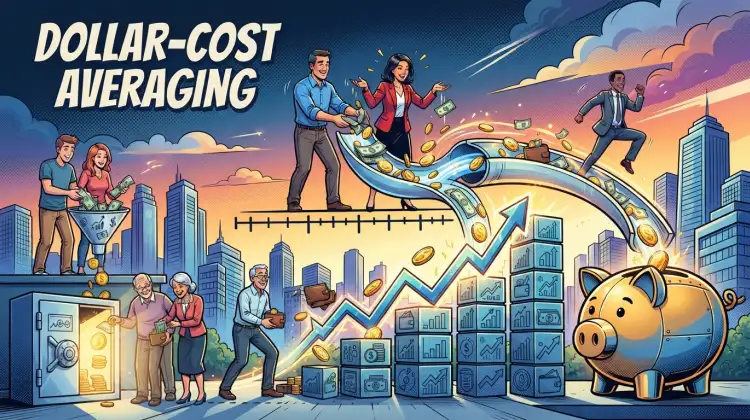
A dollar-cost averaging strategy means investing a fixed dollar amount at regular intervals—say, $500 every month into a diversified index fund—regardless of what the market is doing. Instead of trying to time the market, you buy more shares when prices are low and fewer when prices are high, which smooths your average purchase price over time. It is one of the simplest and most durable approaches available to individual investors in the US, and it is built into the way most workplace retirement plans already work.
This guide explains how the mechanics work, where the strategy genuinely helps, where it falls short, and how to put it into practice inside a 401(k), IRA, or taxable brokerage account.
How Dollar-Cost Averaging Actually Works
The math is straightforward. Suppose you invest $300 every month into an S&P 500 index fund. In a month when the fund trades at $30 per share, you buy 10 shares. In a month when it trades at $25, you buy 12 shares. Over time, your average cost per share tends to land below the average price of the period, because your fixed budget buys more shares during dips.
That mechanical advantage is real but modest. The bigger benefit is behavioral: a fixed schedule removes the emotional decision of when to buy, which is where many investors make costly mistakes. Research on investor behavior has repeatedly shown that attempting to time markets leads to worse outcomes than staying invested.
A simple illustration
- Month 1: $300 at $30/share = 10 shares
- Month 2: $300 at $20/share = 15 shares
- Month 3: $300 at $25/share = 12 shares
- Total: $900 invested for 37 shares, an average cost of about $24.32—below the $25 average share price across those months
Dollar-Cost Averaging vs. Lump-Sum Investing
The most common question is whether it is better to invest a large sum all at once or spread it out. Academic research, including a widely cited Vanguard study, has found that lump-sum investing outperforms dollar-cost averaging roughly two-thirds of the time in markets that rise over the long run—simply because money invested earlier has more time to compound.
That does not make dollar-cost averaging a bad choice. The trade-off is between expected return and risk. Spreading a windfall over 6 to 12 months reduces the chance you invest right before a sharp decline, at the cost of some expected return. For most people, the decision depends on the size of the sum relative to their portfolio and how they would react to an immediate 20% drop.
Where the Strategy Fits in US Accounts
Dollar-cost averaging is already the default for millions of American workers. Contributions to a 401(k) or 403(b) are deducted from each paycheck and invested on a set schedule, often through a target-date fund or index fund lineup. If you are eligible for an employer match, those contributions are typically matched per pay period, which reinforces the cadence.
For individual retirement accounts and taxable brokerage accounts, most major custodians—Fidelity, Charles Schwab, and Vanguard among them—let you set up automatic recurring investments into mutual funds and, increasingly, fractional shares of ETFs. You choose the dollar amount, the frequency (weekly, biweekly, or monthly), and the fund; the brokerage handles the rest.
Practical setup checklist
- Decide on a fixed dollar amount you can sustain through good months and bad.
- Choose a low-cost, diversified fund—broad-market index funds and ETFs typically carry expense ratios under 0.10%.
- Automate the transfer so it happens on payday, before you have a chance to spend the money.
- Increase the amount whenever your income rises, a practice sometimes called a savings escalator.
- Leave the schedule alone during downturns; those are the months your fixed dollars buy the most shares.
Limitations and Common Misconceptions
Dollar-cost averaging is not a guarantee against losses. If the market declines steadily for years, your average cost will fall, but your account value will still be down. The strategy manages timing risk and behavior—it does not eliminate market risk.
It also is not the same as rebalancing. Rebalancing adjusts your mix of stocks and bonds back to target weights; dollar-cost averaging controls when and how new money enters. The two work well together, but they solve different problems.
Finally, beware of the version of this strategy that keeps cash on the sidelines indefinitely. Holding a large sum in a savings account while slowly trickling it in over many years is not dollar-cost averaging—it is market timing with extra steps, and the opportunity cost can be substantial.
What to Remember
Dollar-cost averaging is a disciplined, low-effort way to invest consistently, and it is the natural operating mode of most US retirement accounts. It will not beat lump-sum investing in a rising market, but it reduces the risk of bad timing and, more importantly, removes the emotional friction that keeps people from investing at all. Pick a low-cost fund, automate a fixed contribution, raise it as your income grows, and let the schedule—not your feelings about the headlines—drive your decisions.