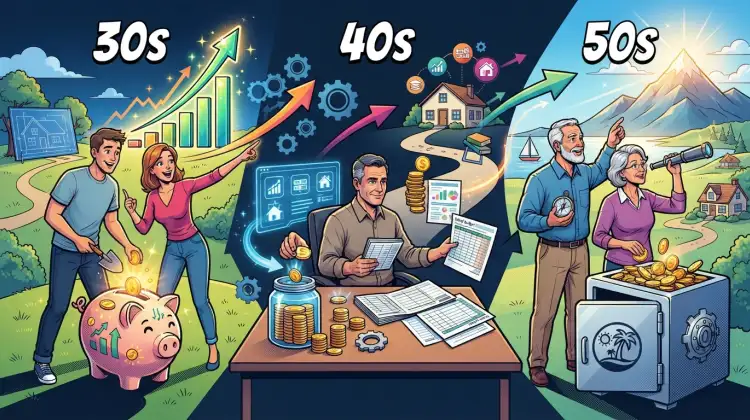
Retirement planning is not a single decision you make once. It is a series of adjustments, and the moves that make sense at 30 are rarely the same ones that make sense at 50. A worker who starts at 30 has roughly 35 years of compounding ahead; someone starting at 50 has about 15. That difference in time horizon changes how much you need to save, how aggressively you should invest, and which accounts deserve priority. This guide breaks down retirement planning at 30, 40, and 50 so you can match your strategy to your stage of life.
Why Your Age Changes the Math
The core variable in retirement planning is time. Compound growth rewards early contributions disproportionately because each dollar has more years to earn returns. According to Fidelity's retirement savings guidelines, a common benchmark is to have saved about one times your salary by age 30, three times by 40, six times by 50, and eight times by 60, assuming you retire at 67. These are rules of thumb, not rules of law — your income, expenses, and expected Social Security benefits all matter — but they give you a useful checkpoint.
Equally important is your savings rate. Financial planners often point to a 15% annual savings rate (including any employer match) as a reasonable target for a worker who starts in their late 20s and wants to maintain their standard of living in retirement. If you start later, the required rate rises, which is why the 40s and 50s often call for larger contributions rather than different investments alone.
Retirement Planning at 30: Build the Habit and Capture Free Money
In your 30s, the priority is establishing systems that run automatically for decades. You have the longest runway, so small increases now have outsized effects later.
- Capture the full employer match. A 401(k) match is an immediate, guaranteed return. Contribute at least enough to get every dollar your employer offers.
- Open a Roth IRA if eligible. In 2025, the IRA contribution limit is $7,000 ($8,000 if you are 50 or older). Roth contributions are made with after-tax dollars, and qualified withdrawals in retirement are tax-free. At a lower salary early in your career, a Roth often makes sense.
- Invest for growth. With 30-plus years ahead, a portfolio weighted heavily toward stock index funds is generally appropriate. Expect volatility and do not react to it.
- Avoid early withdrawals. Withdrawing from a 401(k) or traditional IRA before age 59½ typically triggers income tax plus a 10% penalty, and it permanently removes money that would have compounded.
A 30-year-old earning $70,000 who saves 15% ($10,500 per year) and earns an average 6% annual return could accumulate well over $1 million by 67, before accounting for raises or inflation. The habit matters more than the perfect fund selection.
Retirement Planning at 40: Catch Up and Get Intentional
By 40, the math gets less forgiving. You likely have 25 years left, plus competing priorities: a mortgage, childcare, and aging parents. This is the decade to check whether your savings rate matches your goals.
- Run a real projection. Use a retirement calculator that accounts for Social Security, inflation, and expected expenses. A target of replacing 70–80% of pre-retirement income is a common planning assumption.
- Increase contributions with every raise. Automatically escalate your 401(k) deferral by 1% each year. Many plans offer auto-escalation features.
- Diversify beyond stocks. Consider adding bond funds and, if appropriate, international exposure. Your asset allocation should begin shifting modestly toward stability, though at 40 you still have decades of growth ahead.
- Review beneficiary designations and insurance. Update your 401(k) and IRA beneficiaries, and confirm you have adequate term life and disability coverage to protect the plan if something happens to you.
If you are behind the three-times-salary benchmark at 40, do not panic — but do act. Raising your savings rate by a few percentage points now is far easier than trying to close the gap at 55.
Retirement Planning at 50: Maximize Catch-Up Contributions and Plan for Taxes
The decade of your 50s is the last full stretch of peak earning years, and the tax code gives you tools to use it well.
- Use catch-up contributions. Once you turn 50, you can contribute an extra $7,500 to a 401(k) in 2025, on top of the $23,500 standard limit, and an extra $1,000 to an IRA. Workers aged 60–63 have a higher 401(k) catch-up of $11,250 under SECURE 2.0.
- Consider a health savings account. If you are enrolled in a high-deductible health plan, an HSA offers a triple tax advantage — deductible contributions, tax-free growth, and tax-free qualified medical withdrawals — and after 65 it can function like a traditional IRA for non-medical expenses.
- Plan for taxes, not just returns. Withdrawals from traditional 401(k)s and IRAs are taxed as ordinary income. Roth conversions in lower-income years, and tax diversification across account types, can reduce your future tax bill.
- Get specific about timing. Decide when you will claim Social Security. Claiming at 62 permanently reduces your benefit; waiting until your full retirement age (67 for those born in 1960 or later) or age 70 increases it.
At 50, a common benchmark is six times your salary saved. If you are short, the levers are straightforward: save more, work a few years longer, or plan for a more modest retirement lifestyle.
What to Remember
Retirement planning at 30, 40, and 50 is less about picking the perfect investment and more about matching your savings rate and account strategy to your remaining time. In your 30s, automate contributions and capture every employer match. In your 40s, project your numbers honestly and escalate savings with each raise. In your 50s, use catch-up contributions, plan for taxes, and make deliberate decisions about Social Security. Whatever your age, the most powerful step is the next contribution you make.