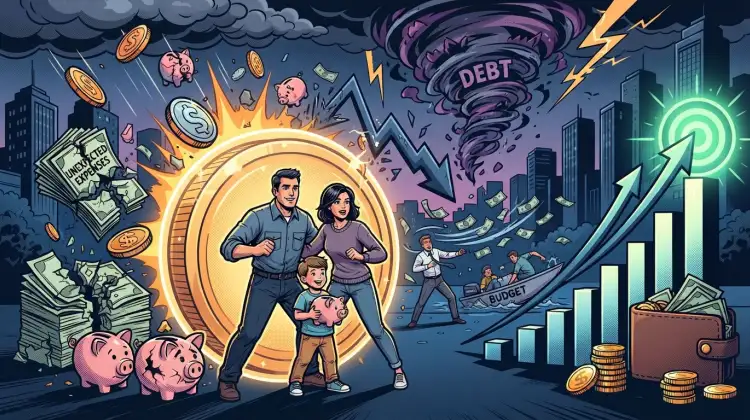
An emergency fund is the financial buffer that keeps a job loss, medical bill, or car repair from turning into a credit card balance you carry for years. The question most people ask is simple: how much should you save? The honest answer is that there is no single number that fits everyone. The widely cited rule of thumb is three to six months of essential expenses, but your ideal target depends on how stable your income is, how many people depend on you, and what other obligations you carry. This guide walks through the standard benchmarks, how to calculate your own number, and where to keep the money so it is safe and accessible.
Why three to six months is the standard starting point
The three-to-six-month guideline is common because it balances two competing needs: having enough cash to cover a real disruption without holding so much that you miss out on higher returns elsewhere. The Federal Reserve's Survey of Household Economics and Decisionmaking has repeatedly found that a meaningful share of U.S. adults say they could not cover an unexpected $400 expense with cash or its equivalent, which is why even a modest cushion matters.
Think of the range this way:
- Three months suits people with steady salaried jobs, dual incomes, and few dependents.
- Six months fits single-income households, people with variable or commission-based pay, and those supporting children or aging parents.
- Nine to twelve months is reasonable for freelancers, small-business owners, workers in volatile industries, or anyone with a chronic health condition that could interrupt income.
The key word is expenses, not income. You are funding survival, not your current lifestyle.
How to calculate your personal target
Start by listing your essential monthly costs. These are the bills that must be paid even if you lose your job: rent or mortgage, utilities, groceries, insurance premiums, minimum debt payments, transportation, and necessary medications. Leave out dining out, subscriptions, travel, and other discretionary spending.
For a concrete example, suppose your essentials total $3,200 a month. A three-month fund is $9,600; a six-month fund is $19,200. If you are self-employed, a nine-month fund is $28,800. Writing that number down turns a vague worry into a savings goal you can track.
Then adjust for risk factors:
- Add months if your income is unpredictable or your industry has frequent layoffs.
- Add months if you are the sole earner or have dependents.
- Add months if you own a home or a car with high repair risk.
- Subtract a little if you have a second stable income, strong job security, and low fixed costs.
Building the fund when the target feels out of reach
A six-month fund can look intimidating, so do not try to reach it in one step. Set an initial goal of $1,000, which covers most common emergencies like a tire replacement or an urgent care visit. Once you hit that milestone, keep going toward one month of expenses, then three, and so on.
Automate the process. Set up a recurring transfer from checking to savings on payday so the money moves before you can spend it. Direct windfalls such as a tax refund, bonus, or side-gig income straight into the fund. If you are juggling high-interest credit card debt, many financial planners suggest building a small starter cushion first, then attacking the debt, then returning to grow the fund, because a 20%+ credit card rate costs more than the fund earns.
Review your target once a year or after any major life change, such as a new job, a move, a marriage, or a new child. Your expenses change, and so should your number.
Where to keep your emergency fund
Safety and access matter more than yield for this money. Keep it in a separate account from your everyday checking so you are not tempted to dip into it, but somewhere you can reach within a day or two.
- High-yield savings accounts at FDIC-insured banks are the most common choice. They are liquid, federally insured up to $250,000 per depositor, and pay more than a traditional savings account.
- Money market accounts offer similar safety with occasional check-writing access.
- Certificates of deposit can work for a portion of the fund if you ladder them, but you may face early-withdrawal penalties.
Avoid stocks, crypto, and long-term investments for this purpose. The whole point is that the balance is stable when you need it, even if markets are down. The FDIC's deposit insurance rules are worth reading so you understand how coverage works across accounts.
What to remember
Your emergency fund target is personal, but the framework is consistent: cover three to six months of essential expenses, adjust upward for income volatility and dependents, and start with a smaller milestone if the full number feels overwhelming. Automate contributions, keep the money in an FDIC-insured savings vehicle, and revisit the target as your life changes. A fully funded emergency fund will not make headlines, but it is the foundation that makes every other financial goal possible.